
Side project: how I built Bizzy, an AI expense app for Israeli freelancers. From sheets pain to a zero-cost, scale-ready MVP with CPA reports and Google Drive sync. Project ended.
TL;DR
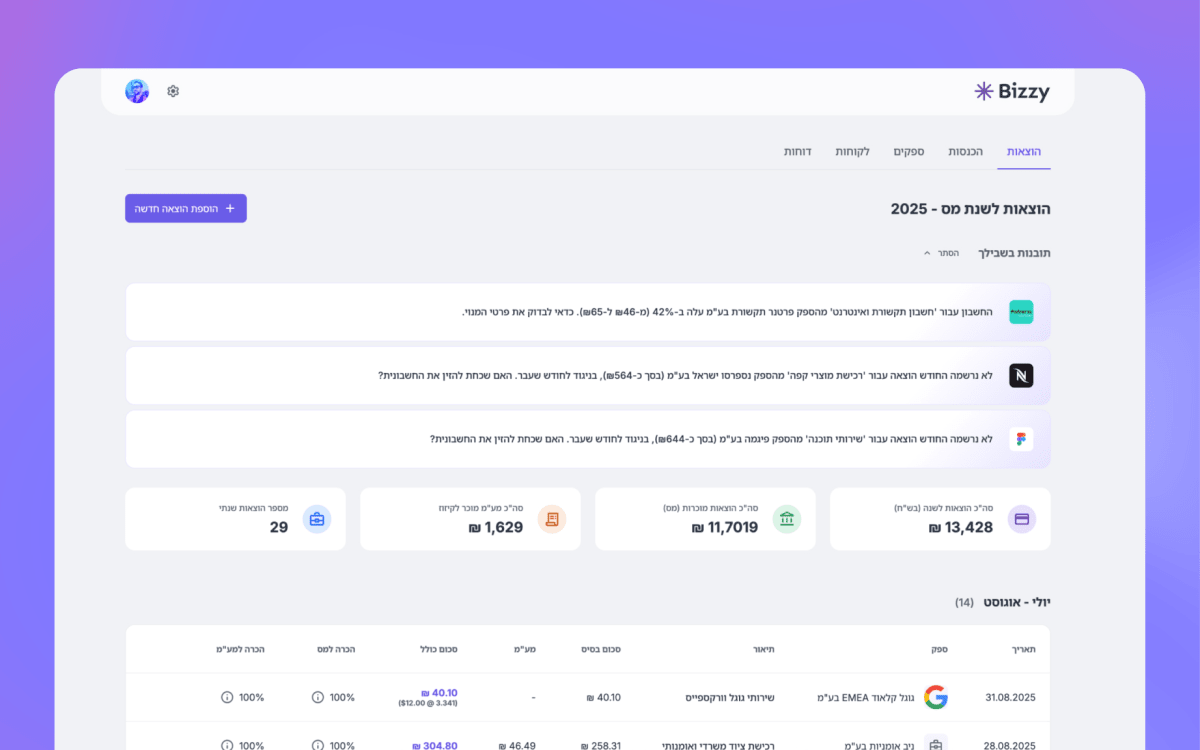
I built Bizzy for myself: an AI-powered business expense app for freelancers under Israel tax law. Sheets were too manual and gave me no insight into what I owed. I worked with AI tools, researched competitors, shipped a one-user POC, used LinkedIn to find design partners, then expanded into a mobile-ready MVP with batch upload, income support, and CPA reports. Zero-cost to run. The project later ended.
The problem
As a freelancer in Israel, I need to manage expenses by tax law, save every receipt, record them properly, and pay taxes every two months. I am not the most organized person, and the tools I tried were not smart enough. They did not give me extra value.
Why sheets did not help
- Too much manual work. It took too much time.
- Paying the right amount of tax was a black box.
- No smart insights from the data I already had.
Goals
- Stop collecting and logging receipts by hand.
- Build a tool that costs me $0 to run.
- Use AI for smart insights, not just storage.
Process
- Build with AI tools I use: Base44, Lovable, AI Studio, Firebase Studio, ChatGPT, VS Code, Claude, Gemini
- Research competitors
- Research Israel tax law and edge cases
- POC product planning and initial scope
- Release for feedback
- Optimization
- MVP planning and scope
- Gradual release and feedback
- Deep optimization
- Go-to-market
Key findings
Competitor analysis showed a clear gap:
- Almost none of the tools used AI in a meaningful way.
- Pricing was high for little extra value.
- Users still did too much manual work.
Initial scope (POC)
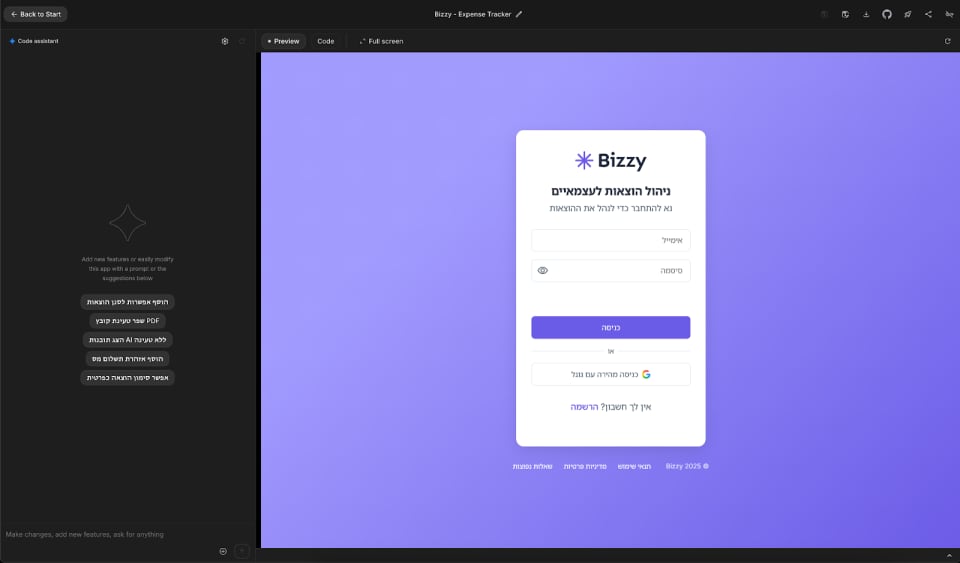
Built for one user: me.
- Use AI to scan and analyze expenses
- Create full reports for my CPA
- Secure database
- Fast and reliable
- Not scalable yet

Design partners
I used LinkedIn to get traction and gather design partners for feedback.
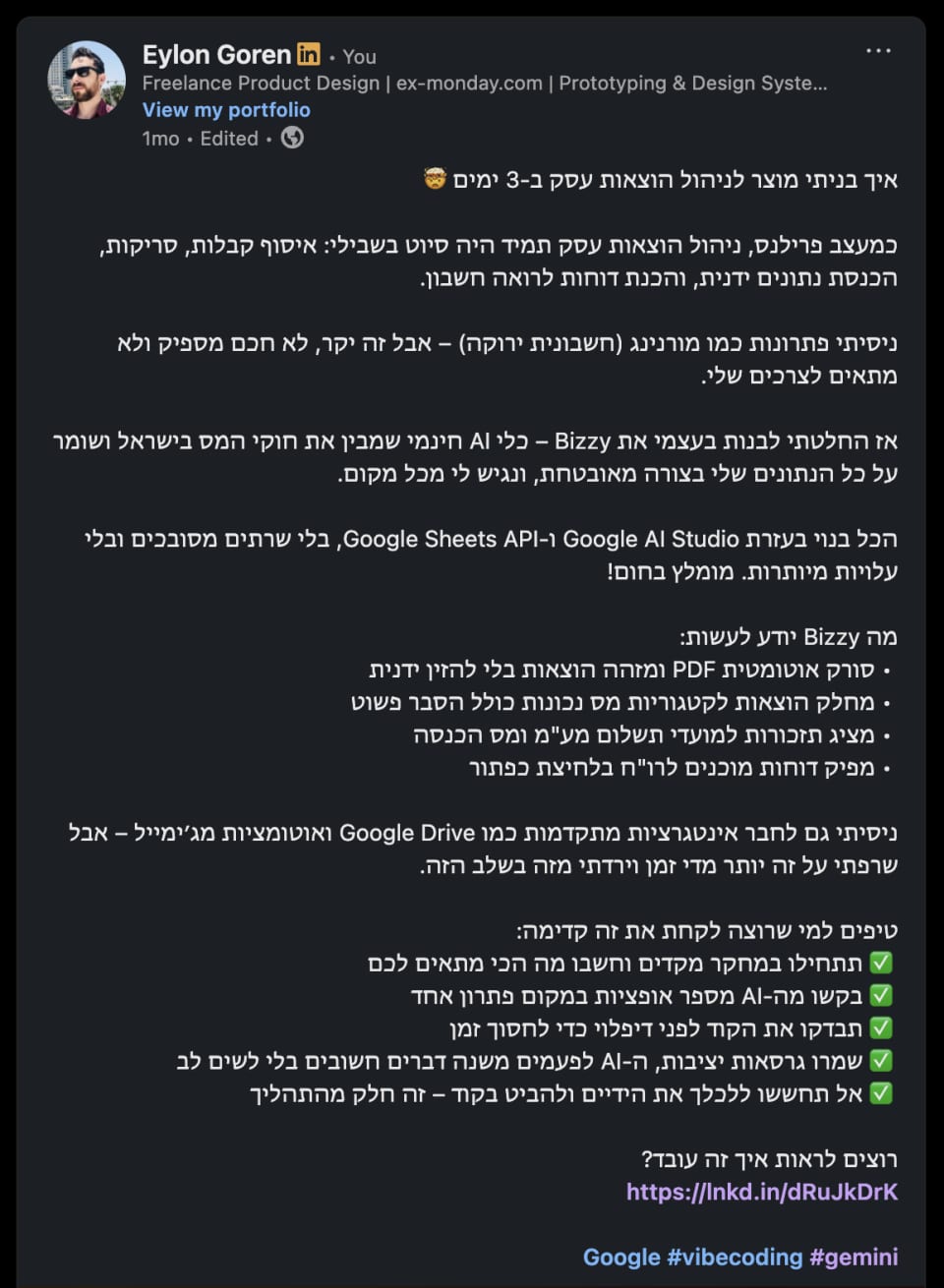
After posting, feature requests poured in:
- Can I upload images too?
- Can you add batch upload?
- What about income? Can I add that as well?
- Does it work on mobile?
And more.
MVP scope (v2)
- Batch upload
- Support for images and PDFs
- Google Drive support
- Advanced reports for CPA
- Scale-ready for 50k users
- Mobile ready
- Income support
- Machine learning for smarter insights
- Onboarding for new users
- User tiers: Free and Pro
And more.
Final MVP
Scale-ready for 50k users. Full UX/UI and front end on React, with Firebase for auth and data, Google Analytics for events, and a design system I built for the product.
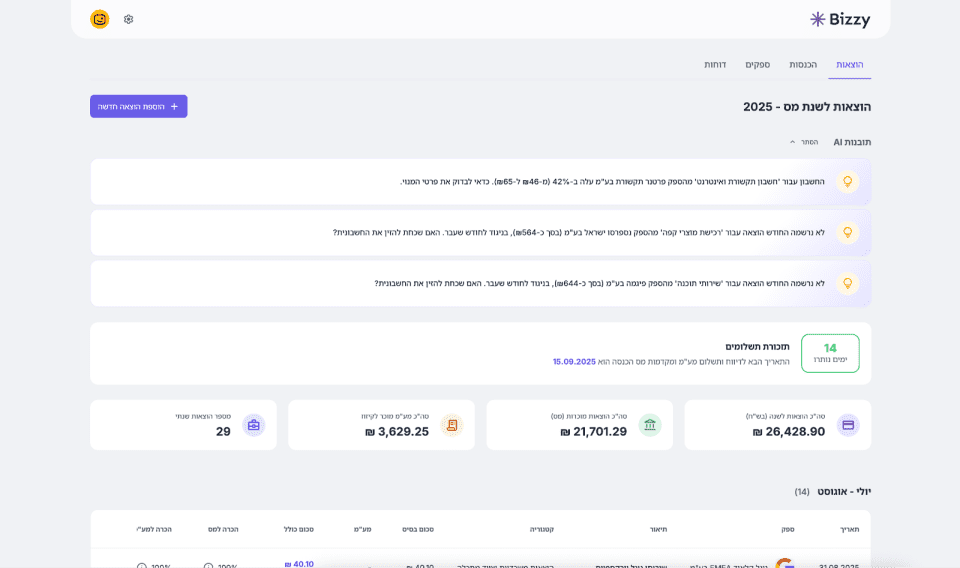
Walkthrough: Bizzy on YouTube.
What I learned
- How React apps are structured and what they can do
- How to store and use APIs securely
- How to structure, index, and store data in Firestore
- How to handle user scale with Firebase
- Event handling with Google Analytics
- How to build my own design system
Takeaway
A real personal pain is the best product brief. Ship a narrow POC, listen in public, then widen scope only when requests prove the need. The project ended after the MVP, but the build taught me end-to-end product craft: research, AI tooling, data, scale, and design as code.
Traction teaser
The short I made to get traction and design partners: